
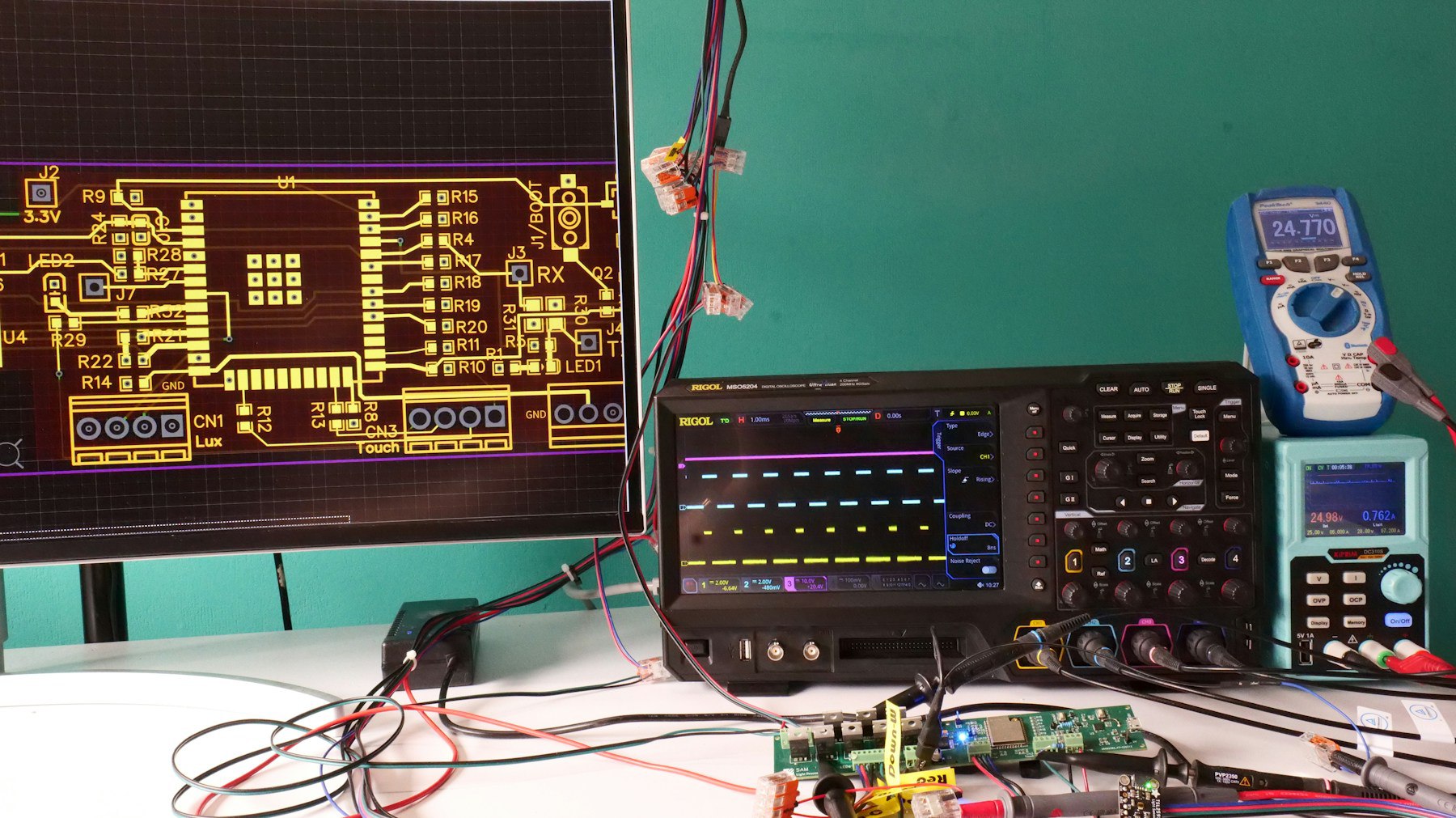
Oscilloscope and electronics workbench; third-party reference photographThird-party reference photograph · © Axel Richter
DUOSERA / ENGINEERING

From the smallest interface
to the complete signal chain.

Organize research on electrodes, electronics, packaging, power, data and interaction through systems engineering. These are engineering plans, not validated capabilities.

E01 / ENGINEERING FOCUS

Electrodes and interfaces

Industry reference · Source: NIH / Jesse Emspak credited on source page Source ↗

Starting at the contact, define the first boundary of the signal chain.

Electrode structures, interconnects and tissue interfaces require joint study. Focus areas include impedance, mechanical stability, noise and long-term operating conditions.

  • Recording targets and geometric layouts
  • Interface and interconnect test conditions
  • Signal-quality evaluation over time
E02 / ENGINEERING FOCUS

Analog front end and system electronics

Industry reference photograph · © Albert Stoynov Source ↗

Bring weak signals into a complete system budget.

Bring the analog front end, data conversion, clock synchronization, processing and telemetry into a shared architecture with interfaces that can be validated individually.

  • Noise, bandwidth and sampling definitions
  • Synchronization, timing and link integrity
  • Power, temperature rise and abnormal states
E03 / ENGINEERING FOCUS

Precision measurement and validation

Industry reference photograph · © Axel Richter Source ↗

Leave reproducible evidence for every design decision.

From module testing to system integration, track consistent conditions, instrument configurations, exceptions and version differences.

  • Traceable inputs and outputs
  • Test conditions, configurations and calibration
  • Failure attribution and repeat validation
E04 / ENGINEERING FOCUS

Packaging, power and long-term reliability

Industry reference photograph · © Laura Ockel Source ↗

Think about long timescales at small scales.

Treat structures, interconnects, sealing, power and thermal design as interdependent questions, and define a reliability-validation path for each design.

  • Material and process boundaries
  • Interconnect and environmental stability
  • Power, temperature rise and maintenance strategies
E05 / ENGINEERING FOCUS

Data and real-time software

Industry reference photograph · © imgix Source ↗

Link data, models and operational states.

Organize acquisition, processing, model and deployment records around the research workflow, making quality issues and version changes traceable.

  • Linking data and model versions
  • Individual calibration and drift monitoring
  • Run logs and rollback mechanisms
E06 / ENGINEERING FOCUS

Human interaction and task evaluation

Industry reference photograph · © ThisIsEngineering Source ↗

From model outputs to usable workflows.

Include training, intent confirmation, error recovery, operational burden and maintenance in design, and evaluate interaction value through concrete tasks.

  • Task and user boundaries
  • Confidence, confirmation and undo
  • Evaluation of real use workflows
FROM COMPONENTS TO EVIDENCE

Make system validation part of every step.

Plan reproducible module tests, system integration and longitudinal evaluation for each design.

01

Define

Define tasks, inputs, outputs, risk boundaries and acceptance criteria.

02

Build

Build an integrable prototype and retain design and configuration versions.

03

Test

Compare expectations with observations, recording exceptions, failures and revisions.

04

Review

Independently reproduce key results and reassess the conditions for the next stage.

THE NEXT CONNECTION STARTS HERE

Explore the next connection. Together.

↗